When I woke up this morning, I was too tired to even bother getting out of bed, so when my alarm went off, I re-set it for an hour later and reluctantly got out of bed then. I don't know why I was so tired, but I expect it has been a long weekend - plus I am not feeling that well. I had a meeting at noon today so I didn't have to get up at 6:30am, which was something I guess.
The meeting over, I went into the Library to do some work, but not before bumping into my beloved Latin teacher. She asked how I was, and I said: ''Haudquaquam calor solis hodie sentio'' (I by no means feel the warmth of the Sun today) which makes no sense at all of course (as she charitably pointed out!), as calor is Nominative! As I keep saying, something will click one day! After the work (frustratingly the printers were out of order) I retired to the stacks for about two hours to do some last-minute pleasure reading before all the work starts. I picked up a 1900 edition of De Imitatione Christi and sat down to read. I had planned on perhaps completing a translation of this pious work over the Summer but those hopes were dashed because of lesser academic commitments. I realised when I got to the counter that I had left my Library card at home! Alas...
At 5:10pm I made my way to Maiden Lane for Mass. Fr Finigan was Celebrant and I was his Master of Ceremonies. It would have been a boring Ferial Mass (a missed opportunity for Tolkien's Requiem, never mind) but instead we had the Mass of St Placidus, a disciple of the great St Benedict. It was a shame that it is term time though - we'd have had a full compliment of young servers then! I have just watched that video of Fr Reginald Foster on Fr Finigan's blog and was quite touched by it. I aspire to be fluent in Latin one day, but I doubt I could ever match Reggie's enthusiasm for the language. I think I am most enthusiastic about Tolkien at present...
Tuesday, 6 October 2009
Sunday, 4 October 2009
The Lay of Leithian, Part II...
It is told in the Lay of Leithian that Lúthien fled from Beren even as the dawn of the Day was at hand, and he lay in a swoon as one who is slain. The Lay continues:
He lay upon the leafy mould,
his face upon earth's bosom cold,
aswoon in overwhelming bliss,
enchanted of an elvish kiss,
seeing within his darkened eyes
the light that for no darkness dies,
the loveliness that doth not fade,
though all in ashes cold be laid.
And he begun the payment of anguish for the fate that was laid upon him. But beyond his hope she returned to him, and long ago in the Hidden Kingdom she laid his hand in his.
Beyond all hope her feet returned
at eve, when in the sky there burned
the flame of stars; and in her eyes
there trembled the starlight of the skies,
and from her hair the fragrance fell
of elvenflowers in elven-dell.
Great was their happiness, and together they walked the woods and sang as they went. But Daeron espied them, and he was wrathful, for he too loved Lúthien.
''Hateful art thou, O Land of Trees!
May fear and silence on thee seize!
My flute shall fall from idle hand
and mirth shall leave Beleriand;
music shall perish and voices fail
and trees stand dumb in dell and dale!''
Many noticed the hush upon the land, and Thingol asked Daeron why this should be so, and thus were Beren and Lúthien betrayed to the King.
Nivea! Nivea!

Since it is a special Marian feast in our parish, I thought I'd post one of my favourite ''Marian'' hymns from The Lord of the Rings. Enjoy:
Snow-white! Snow-white! O Lady clear!
O Queen beyond the Western Seas!
O Light to us that wander here
amid the world of woven trees!
Gilthoniel! O Elbereth!
Clear are thy eyes and bright thy breath!
Snow-white! Snow-white! We sing to thee
in a far land beyond the Sea.
O stars that in the Sunless Year
with shining hands by her were sown,
in windy fields now bright and clear
we see your silver blossom blown!
O Elbereth! Gilthoniel!
We still remember, we who dwell
in this far land beneath the trees,
thy starlight on the Western Seas.
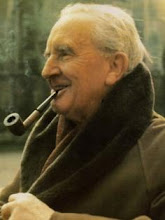
J.R.R Tolkien kept a Rosary forever at his bedside. He was so pious...
Solidarity...

I have to go back out in a minute for the Rosary Procession at my parish, but I thought I'd squeeze a quick post in before so. Yesterday morning at Mass and Benediction I began to think about things I had not really truly considered before. It occurred during the O Salutaris Hostia that I realised that I was chanting along with the very same liturgical hymns that J.R.R Tolkien himself would have chanted. Of course, I knew this before, but I hadn't thought much about it, as it were. This is one of the amazing things about the Catholic faith; it is catholic across time as well as space - linguistically too, not just in terms of the faith. Since the genius of the Church is to use a non-vernacular Sacred Language, the best of them all too (I love Latin!), we can rest assured that perhaps unlike our ''separated brethren,'' our common faith as Catholics is exactly the same as the faith of all the holy and heroic Saints and Confessors who came before us, such as St Edward the Confessor, or even closer to our own time J.R.R Tolkien (my mother was a school-girl when he died).
I had thought of taking down the previous post (someone at my parish had read it), but it received an encouraging comment, and perhaps by venting frustration in some small way we can clear the way for God's Grace. Small things at a time...
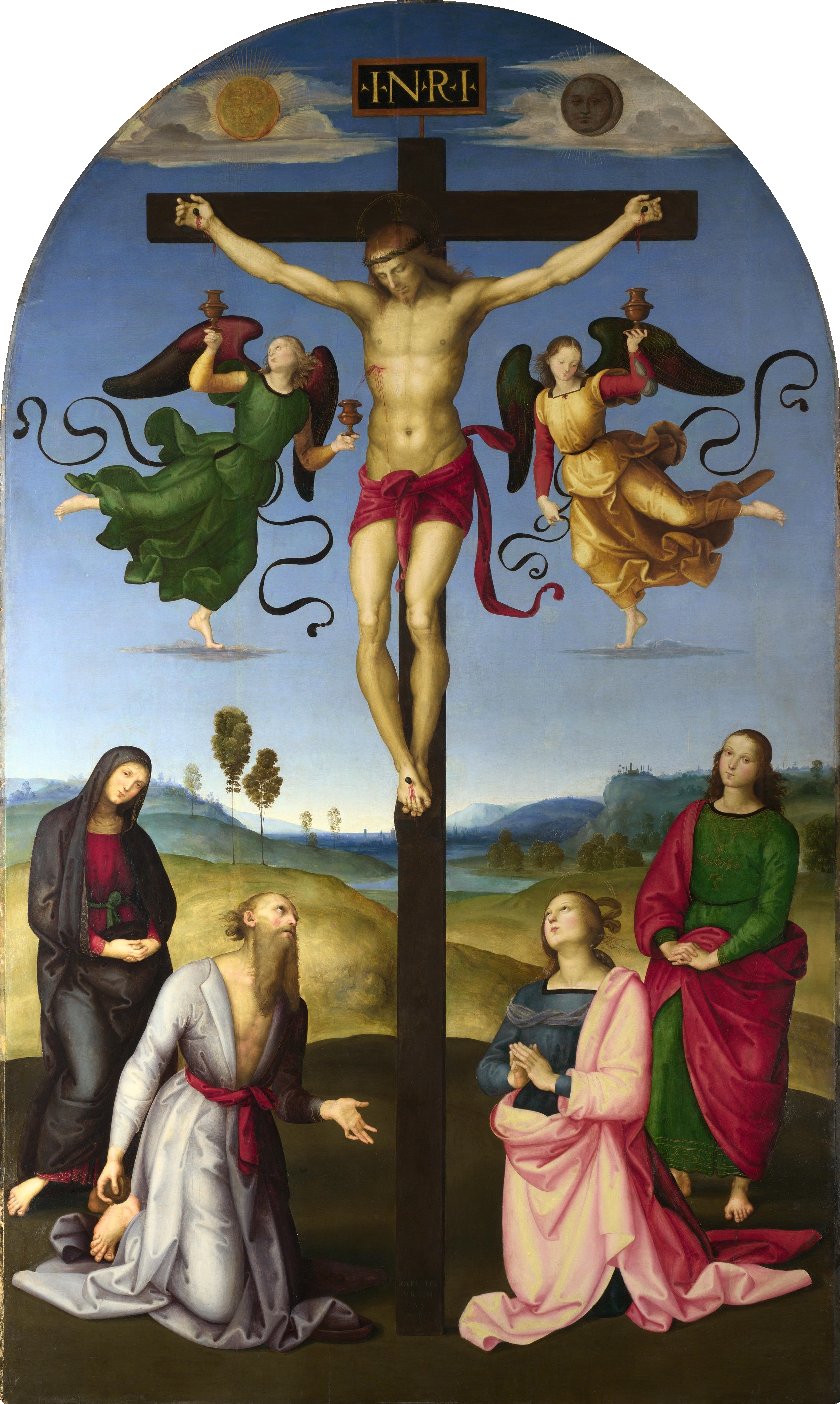
The above painting is probably my favourite depiction of The Crucifixion, and is by the Renaissance master Pietro Perugino. Michelangelo was of course not the only one who painted the Sistine Chapel!
Saturday, 3 October 2009
Lessons in humility...
Today is the Feast of St Therese of the Infant Jesus. I have no particular devotion to her, but Fr Finigan spoke of a certain incident in his Sermon on her life this morning - that she was accused (wrongly) by her Mother Superior (who didn't like her very much) of breaking a vase, amongst other imperfections against the Holy Rule, but that she just apologised and carried on. This is an example of true humility - the ability to accept gratefully any humiliation or wrong in the knowledge that it is as nothing compared with the suffering of Our Lord. It is all well and good feeling remorse about our faults during Sermons and Liturgy though, but actually living out the Christian life is infinitely more difficult. I have just come in from an agonizingly bad day at work (even worse than usual), and thinking about it now (perforce) just makes me realise how spectacularly I fail at humility - or for that matter, just about every other Christian virtue. I cordially loathe my job, everything about it; I find it demeaning and depressing beyond my worst nightmare. Today was especially bad because I was being spied on by a Manager, after which I had a sort of informal ''appraisal'' about how best to offer customer service and other retail merchandising hogwash. I scored 9/10 (probably only that high because I knew I was being spied on), which means that I have to undergo the whole thing again. The thing I failed on was not smiling, not making eye contact and not instigating a conversation with the customer. He did explain to me that a supervisor had informed him that I found eye-contact somewhat difficult, but that still didn't stop him putting the cross in the box. He then went into a well-rehearsed ''lecture'' on more retail rubbish (I am trying desperately not to swear!) and I just sat there nodding, thinking: ''this means nothing whatsoever to me'' (or something conveying a similar sentiment). I then explained in the most diplomatic terms I could devise how the nature of this specific work was unsuitable for me and that I was eager to go back to my old quasi-respectable job.
Later on, I had the ''customer-from-hell'' - a woman with a chip on both shoulders. Without going into details, she just managed to create a scene and cause everyone within the vicinity an inconvenience just because she couldn't add up. After arguing with her for about 20 minutes, a supervisor graciously intervened and I just sat back feeling especially bitter about things. This is what I mean about conveniently forgetting about the requirements of one's faith when thrown in the deep end and asked to put it into practice. I just wish I could get out of it. For what I put up with at work, it makes me almost weep to think about what I am paid for it. The things I would like out of working life are dignity, respect, recognition, quiet, intellect and enjoyment - my current occupation is devoid of all those things, and what is worse, is that the prospect of these desired things is slowly slipping away. I need a miracle, and certainly lots of prayers.
Am I too bitter and dismissive? I may yet be immature in the spiritual life, but perhaps one can say that at least the desire for Christian perfection is there. I just need to clear out the cobwebs of resentment and arrogance so that the light of God's love can pervade over my soul. I may read St Therese's Little Way when I get time, small things at a time and all that.
Later on, I had the ''customer-from-hell'' - a woman with a chip on both shoulders. Without going into details, she just managed to create a scene and cause everyone within the vicinity an inconvenience just because she couldn't add up. After arguing with her for about 20 minutes, a supervisor graciously intervened and I just sat back feeling especially bitter about things. This is what I mean about conveniently forgetting about the requirements of one's faith when thrown in the deep end and asked to put it into practice. I just wish I could get out of it. For what I put up with at work, it makes me almost weep to think about what I am paid for it. The things I would like out of working life are dignity, respect, recognition, quiet, intellect and enjoyment - my current occupation is devoid of all those things, and what is worse, is that the prospect of these desired things is slowly slipping away. I need a miracle, and certainly lots of prayers.
Am I too bitter and dismissive? I may yet be immature in the spiritual life, but perhaps one can say that at least the desire for Christian perfection is there. I just need to clear out the cobwebs of resentment and arrogance so that the light of God's love can pervade over my soul. I may read St Therese's Little Way when I get time, small things at a time and all that.
Friday, 2 October 2009
Oratio Dominica in lingua Eldarum...
For any readers who like this sort of thing, here is the Lord's Prayer in Quenya. Tolkien composed this in the 1950s:
Átaremma i ëa han ëa, na aire esselya, aranielya na tuluva, na care indómelya cemende tambe Erumande. Ámen anta síra ilaurëa massamma, ar ámen apsene úcaremmar sív' emme apsenet tien i úcarer emmen. Álame tulya úsahtienna mal áme etelehta ulcullo.
Násie.
Átaremma i ëa han ëa, na aire esselya, aranielya na tuluva, na care indómelya cemende tambe Erumande. Ámen anta síra ilaurëa massamma, ar ámen apsene úcaremmar sív' emme apsenet tien i úcarer emmen. Álame tulya úsahtienna mal áme etelehta ulcullo.
Násie.
The Lay of Leithian, Part I...

It is told in the Lay of Leithian that Beren came into Doriath the mere shadow of a man, the last Man of Dorthonion, bent and weary with a long exile and the torment of the dark vales of Ered Gorgoroth. But coming upon Lúthien dancing among the hemlocks on a summer evening and all weariness left his limbs and he was as one under a spell of enchantment. But Lúthien fled from Beren, and he wandered once again, only this time he was dumb, but in his heart he called her Tinúviel, which is Nightingale in the tongue of Beleriand. He wandered long, until Autumn and Winter were passed and the first signs of Spring were come, and once again he saw her, dancing upon a hillock, only this time she sang also. The Lay continues:
Thereafter on a hillock green
he saw far off the elven-sheen
of shining limb and jewel bright
often and oft on moonlit night;
and Dairon's pipe awoke once more,
and soft she sang as once before.
Then nigh he stole beneath the trees,
and heartache mingled with hearts-ease.
A night there was when winter died;
then all alone she sang and cried
and danced until the dawn of spring,
and chanted some wild magic thing
that stirred him, till it sudden broke
the bonds that held him, and he woke
to madness sweet and brave despair.
He flung his arms to the night air,
and out he danced unheeding, fleet,
enchanted, with enchanted feet.
He sped towards the hillock green,
the lissom limbs, the dancing sheen;
he leapt upon the grassy hill
his arms were empty, and she fled;
away, away her white feet sped.
But as she went he swiftly came
and called her with the tender name
of nightingales in the elvish tongue,
that all the woods now sudden rung:
''Tinúviel! Tinúviel!''
And clear his voice was as a bell;
its echoes wove a binding spell:
''Tinúviel! Tinúviel!''
His voice such love and longing filled
one moment stood she, fear was stilled;
one moment only; like a flame
he leapt towards her as she stayed
and caught and kissed that elfin maid.
As love there woke in sweet surprise
the starlight trembled in her eyes.
A! Lúthien! A! Lúthien!
more fair than any child of Men;
O! loveliest maid of Elfinesse,
what madness does thee now possess!
A! lissom limbs and shadowy hair
and chaplet of white snowdrops there;
O! starry diadem and white
pale hands beneath the pale moonlight!
She left his arms and slipped away
just at the breaking of the day.
The above image is again by Ted Nasmith - one of his ''sketches.''
A dove looked in...

Here is my translation of that wonderful Sequence Columba aspexit. I had two hours of free time yesterday, so instead of going to read old books of ceremonies or Tolkien, I did some Latin instead (which was probably the best option). It was fun to translate, since it was relatively easy, and it is a wonderfully beautiful piece of Latin. Enjoy!
A dove looked in
through the lattice windows,
where before its face
by sweating, there sweated balm
from bright Maximinus.
The warmth of the sun kindled
and in the shadows shone brightly,
whence a jewel arose
in the building of the temple,
a heart of the purest rich devotion.
He, the lofty tower,
of Lebanon's wood and cypress wrought,
with jacinth and carnelian was adorned,
the city surpassing the arts
of other artists.
The swift hart himself hastened
to the fountain of the purest water,
flowing from the strongest stone
which has diffused the sweet spices.
O painters,
you who are in the sweetest green
of the gardens of the king,
ascending to the height,
when you have finished the holy sacrifice
with the rams.
This artist shines among you
the wall of the temple
he who desired the wings of an eagle
by kissing the nurse Wisdom,
in the glorious fecundity of the Church.
O Maximinus
you are a mountain and a valley,
and in both you appear a high edifice,
where the he-goat with the elephant went out
and Wisdom has been in sweetness.
You are strong
and sweet in the ceremonies
and in the gleaming of the altar
ascending as an aromatic smoke
to the column of praise.
Where you intercede for the people
who reach out to the mirror of light
to whom there is praise on high.
If I have committed any careless solecism, then I ask the pardon of any irate Latinist out there! The Church is indeed gloriously fecund, as Bl. Hildegard says in this wonderful Sequence, because works such as these represent not only a certain mastery of Latin but also the devotion of her sons. I am not aware that anything beautiful has been composed in recent years by any devout and decorous son of the Church - maybe this is because of the general declension in ''Catholicness'' and the near universal loss of Latin in the last however many years. Give me Medieval Sequences anyday over Shine Jesus Shine and guitars! Confessedly, I had never heard of St Maximinus before I came across this Sequence, but whenever his Feast day is in the Old Rite, we'll have to make use of this Sequence in his Mass! (I wonder if that constitutes flying in the face of the regrettable Tridentine reforms?)
Wednesday, 30 September 2009
Columba aspexit...

I have said before that one of my liturgical interests is the plethora of Sequences in the Latin Rite. All but four were suppressed by the Missal of Pius V, a grievous loss in my opinion. I guess all that ''organic development'' of the Liturgy demanded their curtailment. Anyway, one of my favourite Medieval Sequences is the Columba aspexit, composed by Hildegard von Bingen, a 12th century German Benedictine mystic in honour of St Maximinus, the 4th century Bishop of Trier. I must find out more about this pious woman, she was clearly very gifted and apparently had visions (which modern science attributes to migraines!). Anyway, you can listen to Emma Kirkby chant the beautiful Sequence on YouTube. Here is the text:
Columba aspexit
per cancellos fenestrae
ubi ante faciem eius
sudando sudavit balsamum
de lucido Maximino.
Calor solis exarsit
et in tenebras resplenduit
unde gemma surrexit
in aedificatione templi
purissimi cor dis benevoli.
Iste turris excelsa,
de ligno Libani et cupresso facta,
iacincto et sardio ornata est,
urbs praecellens artes
aliorum artificium.
Ipse velox cervus cucurrit
ad fontem purissimae aquae
fluentis de fortissimo lapide
qui dulcia aromata irrigavit.
O pigmentari
qui estis in suavissima viriditate
hortorum regis,
ascendentes in altum
quando sanctum sacrificium
in arietibus perfecistis.
Inter vos fulget hic artifex,
paries templi,
qui desideravit alas aquilae
osculando nutricem Sapientiam
in gloriosa fecunditate Ecclesiae.
O Maximine,
mons et vallis es,
et in utroque alta aedificatio appares,
ubi capricornus cum elephante exivit,
et Sapientia in deliciis fuit.
Tu es fortis
et suavis in caerimoniis
et in coruscatiane altaris,
ascendens ut fumus aromatum
ad columnam laudis.
Ubi intercedis pro populo
qui tendit ad speculum lucis,
cui laus est in altis.
I must do a thorough translation of this when I get the time. The eighth stanza reads: ''Thou art strong and sweet in the ceremonies and in the shining [coruscatione seems to connote tremulous light, like that of the sun seen through the leaves of trees] of the Altar, ascending as an aromatic smoke to the column of praise.'' Notice how strange the style of pronunciation is, it's neither purely Classical nor Ecclesiastical but a strange mix of the two! Enjoy!
Tuesday, 29 September 2009
Asperger's and I...

''People with Asperger's syndrome are natural experts.'' (Tony Attwood, The Complete Guide to Asperger's Syndrome, Chapter VII, Special Interests, p. 178).
I thought I'd develop a post about Asperger Syndrome and how ''special interest'' relate to academia, since I find this interesting and perhaps some of my readers do also. Although people with Asperger Syndrome have difficulties in reciprocal social interaction (the intensity of this can decrease over time), most have a remarkable ability in a chosen area of expertise. In 1944, Hans Asperger wrote of one of his patients:
''Another autistic [it was not, of course, known as ''Asperger Syndrome'' in those days, but by a strange term - ''autistic psychopathy''] child had specialized technological interests and knew an incredible amount about complex machinery. He acquired this knowledge through constant questioning, which it was impossible to fend off, and also to a great degree through his own observations.''
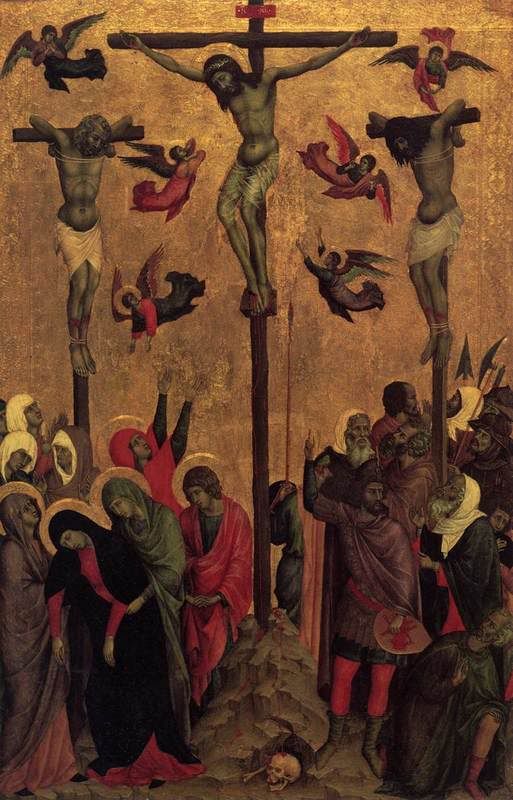
An essential component of a specialized interest for someone with Asperger Syndrome is the accumulation and categorization of facts and the collection and cataloguing of objects related to it (such as books). Since, however, the ''special interest'' is of clinical significance, the interest is more than a mere hobby. Indeed, what makes the special interest of clinical significance is the abnormality of its intensity or focus. I was always good at drawing as a child (my Primary School teachers used to ''use me'' to draw school displays on what we had studied, such as the Romans), but until I was about 7 years old, I used to draw nothing but Crucifixes or depictions of the Crucifixion - they were accurate as well, after the manner of Duccio who painted accurate crucifixions, even if other depictions, such as that of Perugino or Raphael, tend to be more aesthetically pleasing! I clearly remember the first thing I think I ever drew which was not a Crucifix (after a thrashing from my mother, who was always more strict with me, because I was ''odd,'' than with my siblings) was the Apple Tree at the bottom of our garden - my mother kept it, but I haven't seen it since. I remember being tempted to depict Christ's Corpus suspended from the branches, remembering that someone had said that: ''the Lord reigns from the Tree,'' but I knew that this would upset my mother and so I left it out.
I am not so close to classic Autism on the Autistic Spectrum as to have remained altogether unchanged in my special interests over the years. My interest in Crucifixes has developed into a general interest in Religious art and the history of Art. This is comparatively common in in many children with Asperger Syndrome. The complexity and number of interests differs according to developmental and intellectual factors; some children can develop interests in specific periods of history (in my case, the Angevin Empire and the early Plantagenets), or some other interest. I used to read the Oxford English Dictionary and was fascinated by the entries, specifically the etymological explanations, which has developed into an interest in the Latin language. Having a strong interest in Art and language, I also became enamoured of styles of script and so my mother brought me a Calligraphy set to practice my handwriting. Unlike most children with Asperger Syndrome, my subtle motor coordinations were not erratic, nor did they fluctuate, and my handwriting has often been described as very neat. Alas, though, I no longer own a calligraphy set - I must acquire one, calligraphy is a noble art, one could say, a special union of Art and Intellect. This subtlety was also exemplified in my perfect sense of rhythm. My mother, as I have said in a previous post, took me to Irish dancing lessons (mostly in her attempts to instill within my siblings and I that we were Irish and not British - the British being equated with Protestantism in the eyes of my family!) and I developed a talent for that, and enjoyed it immensely.
I first read The Hobbit when I was 7 years old. My first copy was in fact a First Holy Communion present (an odd one, most others consisted of Mass books, Rosaries and devotional medals!). I enjoyed it immensely, and still do. I consider the book to be a masterpiece of childrens' literature. Having read and re-read The Hobbit several times, I asked my mother when I was 8 or 9 to find any other books about Hobbits, and so I was presented with the first part of The Lord of the Rings, The Fellowship of the Ring, and I enjoyed that even more than I had enjoyed The Hobbit. By the time I was 13 (at about the time the Peter Jackson trilogy was first shown in cinemas around the world) I had read it about twice a year every year. I think I have only read it once this year, owing to academic pressures (which I will come to in a moment) - this will have to be rectified at Christmas! My mother gave my siblings (I have a younger brother and a younger sister, now 20 and 18 respectively) and I tickets to go and see the trilogy. In hindsight, I must have ruined everyones' experience of the film, because I had to keep telling my sister to shut up (she kept screaming, at the Black Riders mostly - she was only 10 at the time, and talking) and I kept commenting about the differences between the book and the film. When I was 15, I brought my first copy of The Silmarillion, and although I found all the names and different places difficult to remember at first, I enjoyed it greatly. Later I brought Unfinished Tales, and enjoyed that because of the greater detail. At Sixth Form, I began to read The Letters of J.R.R Tolkien and Tolkien's Biography, and I also began to collect the twelve volumes of The History of Middle-earth, beginning with the Lost Tales. Also, I began to read the Classics at Sixth Form - Plato and Aristotle, Homer, Virgil and Cicero - I also began to teach myself the rudiments of Latin. Indeed, I think I learned more in my two years at Sixth Form than I did in five years at school.
And so, having passed my A Levels (I did Religious Studies, Philosophy, History and Fine Art), I went to University to began my studies in Theology and Latin. I was optimistic at first, especially when I received the feedback from my first two essays in Church History and Fundamental Theology, on Origen's interpretation of Scripture and Avery Cardinal Dulles' book on the Models of Revelation respectively, and my first test in Latin (for the first one, we were asked to Conjugate Paro in the Present Tense, and I was given Optime! as the mark!). I got a First for my Church History essay, and a 2:1 for my Fundamental Theology essay - which was described as ''highly conservative and militant'' by my tutor - to my everlasting delight! But soon afterwards, I became too bogged down with making my work ''perfect'' and I spent literally hours over the connotations of single words, and the subtle implications of this point and that, and being so inclined towards my work, I began to miss deadlines and became very depressed and anxious. I felt literally crushed when my essay on the Epic of Gilgamesh and the Genesis Creation story only achieved a 2:1, because I had spent a great deal of time making it ''perfect.'' Some essays I found too beyond my experience as to not bother at all about, and I dropped out of the course soon afterwards. I still have difficulty with time-management and I still cannot shake off my labour-intensive approach to work, but I try now, and I was more than a little encouraged when I got a First for my Latin - although my ''pushy'' mother was disappointed that it was a ''low'' first.
This brings me to one of the points of this post. A friend of mine asked me recently how Asperger Syndrome could possibly have a ''significant impairment in important areas of functioning'' aspect for me, because I seemed to be very polite, shy and intelligent (I don't know about the latter, but that seems to be the general consensus anyway). My answer is that, although I don't tend to think much about it, it pervades over almost every aspect of my life. One ''everyday'' aspect is simply doing the washing up (something I hate doing). I won't go into the minute details, but rest assured that everything has to be clean (thoroughly so) and well-ordered. My mother tells me that where it takes me, say, 2 hours to do the washing up, it would take her about 20 minutes to do the same amount. This is just one example, there are plenty of others (some I had not heretofore thought of in this way, until they were pointed out to me by friends or relatives). My approach to work perfectly encapsulates my academic difficulties. I am a natural perfectionist; something is either worth reading, or it isn't, something is black or white, there is no grey area. If I am asked, absurdly in my opinion, to write an essay on something entirely new to me then I think the better option is to not bother with it, because my appraisal or critique of the subject will be ultimately flawed, less than perfect.
In 1938, Hans Asperger observed:
''Where it is about logical thinking, where the issue is meeting their special interests, they are ahead, surprise their teachers with their clever answers; where it is about more or less mechanical learning by heart, where concentrated learning is demanded (copying, spelling, methods of arithmetic) these 'clever' children fail in a severe kind of way, so that they often are on the brink of failing their exams.''
The idea is that people with Asperger Syndrome have a peculiar profile of intelligence and cognitive ability. I have taken I.Q tests before and they always indicated that I am of below average intelligence. This, to me, indicates a serious discrepancy between what is written on paper and reality. I.Q tests seem to be geared more towards pattern recognition and arithmetic than actual learning. Is somebody's intelligence measurable? This is a complex question and beyond the scope of this post anyway, but it is worth considering. What does ''intelligence'' consist of? Does it entail the ability to memorize facts by rote? One thing that I have learned from some of the feedback from my essays is that I nearly always have a poor box ticked for the assessment criterion called: ''Focus on Key Issues.'' Why is this I wonder? My mother tells me that it is because I ''don't see the wood for the trees'' or some such saying. One tutor commented that he gave me a better mark on an essay not so much because of the content but because he recognized that there was ''intelligence'' behind it. And then there is that ''common sense'' phenomenon, which I will not elaborate here, as I did so in a previous post.
I have often wondered why I struggled so much at University when there were other people, clearly less intelligent than I, who didn't. During lectures, I listened patiently to some of the questions asked, no doubt sincerely, by some of the students, but privately I thought to myself: ''you're studying Theology at University level and you didn't even know that?'' It greatly irritates me that some people have University degrees when in my opinion they don't deserve them (some of my school teachers fall into this category). I personally think it scandalous that some people come out of University, on paper, more qualified than I, with better job prospects than I, and yet cannot string a sentence together without making some grammatical solecism. I am often astounded at how little they know about anything. I would go back to the days when University was the province of the Upper classes and the intelligent. I think it stupid that everyone is encouraged to go to University, because University is not suited to everyone. I also think that to deprive a child of a decent education (as I was) when they have better prospects than their peers is a form of abuse. Sometimes I think that everything I know, at least that which I consider to be of any importance and worth (save Latin), I have in fact taught myself.
I think I had better finish now. What I am going to do in life remains a mystery at present. I am technically irregular by default for Ordination (ever since I was little, everyone has assumed that I would become a priest - fortunately, I have no such vocation anyway!), my Latin is at present too embryonic to do anything with, and Theology is not my area (of course, as Tolkien said, nothing is ever one's sole area - one is either humbly engaged in learning or one obscenely attempts to adorn it - this is what people generally mean when they say ''my subject'' - as an aside, I wonder if this can relate to professional liturgists shut up in the Vatican who devised the Novus Ordo?). People suggest a doctorate in Tolkien - which is not of itself objectionable, but I would rather object to teaching ''Tolkien studies'' to hippies or other unsavoury people, and besides, one needs a respectable degree in order to even ponder doctoral theses. I would like to do Classics though, since devotion to the Classics is perhaps, next to Theology, the noblest form of study.
The above photograph is of Hans Asperger, after whom the condition is named, with one of his ''little professors'' (for so he was accustomed to name his patients).
Sunday, 27 September 2009
A short story by Patricius...

I've had quite a full day and feel rather tired, but I promised a very good friend of mine today that I'd write her a short story to better explain something. And so, this is a story about a special boy named Joseph who saw things differently from most people.
Joseph is 25 years old. Since his earliest days, he has had a remarkably advanced language. He was speaking his first words at 9 months and by 18 months had a vocabulary well-beyond his years. His first word, amusingly, was ''cantankerous'' - probably derived from his father who frequently complained about the elderly woman who lived next door who was more than a little awkward. Joseph's parents were understandably proud of their firstborn son, who by 2 years old could read the small-print on the back of the family VHS tapes.
Joseph went to nursery, where his ''teachers'' were concerned that he was ''living in a bubble.'' When he started school, his social ineptitude became more apparent. He was never interested in other children, but often ''stalked'' the adults about, telling them of his favourite book The Hobbit, and would talk endlessly about it if not interrupted. He spent hours in his bedroom alone, often making lists or writing out the dates of birth of people he knew and working out how much older they were than he. He would often spend considerable time opening and closing doors, manipulating light-switches and curtains, to no purpose that his parents or anyone else could see. He learned the scripts of some of his favourite films (such as Breakfast at Tiffany's, he adored Audrey Hepburn!) by rote, and would often correct relatives if they quoted a film in jest if they got it wrong.
Joseph was frequently in trouble in Primary School for disregarding the school timetable, preferring to sit in the Library alone with history books. When constrained by the Headmaster (who called his parents in because of Joseph's frequent tantrums) to audit lessons, he would often interrupt the teacher if she made a sweeping statement, an assertion of fact or an opinion. The teacher felt troubled, for she could see that Joseph was intelligent and curious, but she was concerned about his disruptive behaviour. And so, Joseph was referred to a Child Guidance Clinic. However, because Joseph's mother thought the therapist team were a ''bunch of hippies,'' he was removed and continued school as normal. Joseph's mother was concerned that the boy be raised ''normal'' like everyone else, and refused support grants, and even the finances to build an extension to their house so that Joseph could have his own separate room away from his brother, with whom he often fought because he was untidy.
Joseph passed his SATs tests with high scores for English but below average scores for Science and Maths, and he went to Secondary School with no great optimism. Secondary School proved even worse for Joseph, where he was bullied by older girls and even by some of the teachers (whom he accused of being in league with them). He became increasingly ''obsessed'' with areas of his interest, such as Art and History and Literature, and he frequently argued with his teachers. He was annoyed that he was accused of being ''pre-occupied'' with a subject long since ''dealt with'' on the Syllabus, and he retorted that if a subject was worth learning, it was salutary to learn everything one could about it rather than briefly going over it. He was shocked at what passed for education at Secondary School (he went to a mainstream school), describing the History syllabus as designed for idiots and constantly truanting from P.E lessons. He little understood what was socially appropriate, when enough was enough, or when he might be considered abusive or boring. It was not all bad though - he got on well with his Art teacher (who allowed him to sit in his classroom during break-times and read his books) and (astoundingly one might say) the Science teachers; his Maths teacher was patient with his attempts at Maths.
Joseph passed his GCSE exams respectfully and went onto Sixth Form College and University. He had little difficulty at Sixth Form, and passed his exams respectfully, starting University with a positive outlook. At University he developed a small group of friends, with whom he had much in common, and while not all the academic topics covered in the Syllabus were to his liking, he tried to get on with them as best he could, but often found procrastination and attention an issue, his attention often being drawn away to ''pleasures'' (since he adored the literary works of Oscar Wilde, he became obsessed with ''youth,'' he did nothing untoward or devious though) such as good food and drink, buying of books, first editions and all sorts. His lifestyle exceeded his income (he had a part-time job, the bane of his life as he called it) and he was often in debt, but his parents, happy that he was getting to be more ''normal'' as each day passed, were proud when he passed his degree. He is now, perforce, alone, but he is content with life as it is, and is often thought of as that ''shy'' but slightly ''odd'' chap who knows a lot about Star Trek...may the Force be with you!!!
The above image is of an ammonite fossil. It has nothing to do with the post, but I like looking at Ammonites, rather like staring into infinity.
The Lay of Leithian, an Introduction...

In later days when Morgoth first,
fleeing the Gods, their bondage burst,
and on the mortal lands set feet,
and in the North his mighty seat
founded and fortified, and all
the newborn race of Men were thrall
unto his power, and Elf and Gnome*
his slaves, or wandered without home,
or scattered fastnesses walled with fear
upraised upon his borders drear,
and each one fell, yet reigned there still
in Doriath beyond his will
Thingol and deathless Melian,
whose magic yet no evil can
that cometh from without surpass.
Here still was laughter and green grass,
and leaves were lit with the white sun,
and many marvels were begun.
In sunshine and in sheen of moon,
with silken robe and silver shoon,
the daugther of the deathless queen
now danced on the undying green,
half elven-fair and half divine;
and when the stars began to shine
unseen but near a piping woke,
and in the branches of an oak,
or seated on the beech-leaves brown,
Dairon** the dark with ferny crown
played with bewildering wizard's art
music for breaking of the heart.
Such players have there only been
thrice in all Elfinesse, I ween:
Tinfang Gelion*** who still the moon
enchants on summer nights of June
and kindles the pale firstling star;
and he who harps upon the far
forgotten beaches and dark shores
where western foam for ever roars,
Maglor whose voice is like the sea;
and Dairon, mightiest of the three.
Now it befell on summer night,
upon a lawn where lingering light
yet lay and faded faint and grey,
that Lúthien danced while he did play.
The chestnuts on the turf had shed
their flowering candles, white and red;
there darkling stood a silent elm
and pale beneath its shadow-helm
there glimmered faint the umbels thick
of hemlocks like a mist, and quick
the moths on pallid wings of white
with tiny eyes of fiery light
were fluttering softly, and the voles
crept out to listen from their holes;
the little owls were hushed and still;
the moon was yet behind the hill.
Her arms like ivory were glimmering,
her long hair like a cloud was streaming,
her feet atwinkle wandered roaming
in misty mazes in the gloaming;
and glowworms shimmered round her feet,
and moths in moving garland fleet
above her head went wavering wan -
and this the moon now looked upon,
uprisen slow, and round, and white
above the branches of the night.
Then clearly thrilled her voice and rang;
with sudden ecstasy she sang
a song of nightingales she learned
and with her elvish magic turned
to such bewildering delight
the moon hung moveless in the night.
And this it was that Beren heard,
and this he saw, without a word,
enchanted dumb, yet filled with fire
of such a wonder and desire
that all his mortal mind was dim;
her magic bound and fettered him,
and faint he leaned against a tree.
Forwandered, wayworn, gaunt was he,
his body sick and heart gone cold,
grey in his hair, his youth turned old;
for those that tread the lonely way
a price of woe and anguish pay.
And now his heart was healed and slain
with a new life and with new pain.
He gazed, and as he gazed her hair
within its cloudy web did snare
the silver moonbeams sifting white
between the leaves, and glinting bright
the tremulous starlight of the skies
was caught and mirrored in her eyes.
Then all his journey's lonely fare,
the hunger and the haggard care,
the awful mountains' stones he stained
with blood of weary feet, and gained
only a land of ghosts, and fear
in dark ravines imprisoned sheer -
there mighty spiders wove their webs,
old creatures foul with birdlike nebs
that span their traps in dizzy air,
and filled it with clinging black despair,
and there they lived, and the sucked the bones
lay white beneath on the dank stones -
now all these horrors like a cloud
faded from mind. The waters loud
falling from pineclad heights no more
he heard, those waters grey and frore
that bittersweet he drank and filled
his mind with madness - all was stilled.
He recked not now the burning road,
the paths demented where he strode
endlessly...and ever new
horizens stretched before his view,
as each blue ridge with bleeding feet
was climbed, and down he went to meet
battle with creatures old and strong
and monsters in the dark, and long,
long watches in the haunted night
while evil shapes the baleful light
in clustered eyes did crawl and snuff
beneath his tree - not half enough
the price he deemed to come at last
to that pale moon when day had passed,
to those clear stars of Elfinesse,
the hearts-ease and the loveliness.
Lo! all forgetting he was drawn
unheeding toward the glimmering lawn
by love and wonder that compelled
his feet from hiding; music welled
within his heart, and songs unmade
on themes unthought-of moved and swayed
his soul with sweetness; out he came,
a shadow in the moon's pale flame -
and Dairon's flute as sudden stops
as lark before it steeply drops,
as grasshopper within the grass
listening for heavy feet to pass.
''Flee, Lúthien!'', and ''Lúthien!''
from hiding Dairon called again;
''A stranger walks the woods! Away!''
Before it gets too long (perhaps I am too late!), I shall stop. This is part of Canto III of The Lay of Leithian as found in The History of Middle-earth Volume III, The Lays of Beleriand - an invaluable book - and tells of the coming of Beren into Doriath and his first sight of Lúthien the Fair, dancing among the hemlocks. As you can see, the Lay is written in the staple octosyllabic couplets of romance, which must be very difficult to compose, and thus we can glimpse through another window into Tolkien's genius. It is a great honour to read Tolkien in verse, because it is how the traditions of the Elder Days were preserved by the Eldar - indeed, the Great Tales of the Elder Days would have been sung in Rivendell to the Hobbits by the minstrels of Elrond in this fashion. From the Lay comes the impoverished chapter ''Of Beren and Lúthien'' in The Silmarillion. It is much better to read it in verse. In my treatment of the synopsis of this great tale, I shall perhaps include one or two stanzas from the Lay, as I think it is important. I shall say no more than ''feast your eyes upon it!''
*Gnome was a name formerly used by Tolkien as synonymous with Noldor. Interestingly, as the the Quenya Istar is related to the English Wizard in the mind of Tolkien, so Noldor was probably philologically related to Gnome. I had not hitheto thought of this.
**Dairon was later changed to Daeron; they remained the same person, although the character was altered considerably between the Lost Tales (where he is conceived to be the brother of Lúthien) to the legends of The Silmarillion.
***Tinfang Gelion, a character resurrected from the Lost Tales. The name Gelion is not explained, although the name was used later to designate a great river in East Beleriand. Tinfang Gelion is not a character in The Silmarillion.
The above image I found in Google Images, and depicts Lúthien dancing. I had already used the Ted Nasmith one, so I thought better of using it again.
Saturday, 26 September 2009
Another Academic Year...

Term starts on Monday, and I am nervous and excited about it. I enjoy getting back into the ''work'' routine, it adds somewhat of a rhythm to my life, which is always needed. I only hope that I can concentrate better this year; after three years of ''taking things easy'' (in a very anxious kind of way!) let's say, I need to get on and do some work. No more procrastinating for me! I think it would be better if I stayed behind until closing time in the Theology Library to do assignments instead of leaving them until I get in, which is perilous because of the many distractions (Tolkien is the chief culprit!) present. I humbly ask my readers to pray for me that I can finally get a Degree so that I can get out of this nightmare of a part-time job. Also, everyone keeps telling me to get on and do my ''doctorate'' in Tolkien!
Subscribe to:
Posts (Atom)