Tuesday, 13 October 2009

Aesthetics and all that...


What is the most beautiful thing in this world? I was thinking about that during the boring Ferial Mass shorn of appropriate commemorations this evening. You'd think that as Master of Ceremonies I'd be focused upon the Celebrant and Servers, but to my sorrow, my mind wandered. Beauty is not, however, something inappropriate to meditate during Mass. I have oft thought of that now hackneyed and irritating expression: ''beauty is in the eye of the beholder.'' It seems to suggest a relativistic and subjective view of the nature of beauty (beauty and beautiful are themselves, incidentally, aesthetically unpleasing words, and are quite embarrassing to say - and to hear sometimes), that the object is a tabula rasa, as it were, with the ''beholder'' projecting upon this faceless object a vision of loveliness - but perhaps there is at least some truth in it. The face of one's beloved is, I suppose, the most beautiful thing to someone in love. The Blessed Sacrament is the most beautiful thing in the world to a homo religiosus. I wonder what the most beautiful thing in the world is to me? I think that to be pierced by something so wonderful, such as reading The Field of Cormallen in The Lord of the Rings, or experiencing the eucatastrophic High Mass, a Marian Feast day, or to be haunted in the most profound and religious sense by the memory of a beautiful loved one (or relative, whatever) is the most beautiful thing in this world, as it suggests purity and poignancy. It is certainly a source of consolation amidst cares and griefs, that however miserable life might be sometimes (and it is downright miserable sometimes), God is the supreme author of loveliness. I had these thoughts also a few nights ago when walking home from church late at night after Benediction. I looked at the Moon, glowing in a frozen sky through the grey clouds, kindled tremulously to silver. My thought was that no one had ever painted it, and that the vision was therefore evanescent, and would disappear beyond all recall, even mine, but that I was privileged to see it. It was extraordinarily pretty. If only all things could be beautiful, as emanating from the love and light of God...

Are these ravings?

Sunday, 11 October 2009

Sitemeter question...

I have just checked my Sitemeter, and one of the referrals to my blog today came from a google question, namely: ''was J.R.R Tolkien an atheist?''

I have no doubt that the question was asked sincerely, but I ask: are atheists even capable of creating works of aesthetic genius?

Which is better...?

Today I have been thinking somewhat about Mass and Vespers. Mass is the jewel in the crown of the Church's liturgical tradition, the meeting point between Heaven and Earth, but which is better? A Solemn Vespers in the Old Rite with six Pluvialistae, sung beautifully by a professional choir in a beautiful church such as Spanish Place or the Oratory, with the ritual carried out splendidly and reverently by the Servers, or a Low Mass in the New Rite with vulgar vernacular hymns? Am I focused too much on the ''externals'' of liturgy? That might well be a charge brought against me by a narrow-minded Modernist, making excuses for an impoverished and somewhat aliturgical ceremony, but we must remember that ceremonies are not the mere window-dressing of Liturgy. Sacred ceremonies go right to the heart of the Church's mystery, and therefore it might be asked...which is superior Liturgy? Sometimes I think that the many, too many, Masses that are on offer have made the mystery of the Mass seem complacent and commonplace to some, even the most sincere Catholics - perhaps a contributing factor in the grotesque liturgical reforms of the 20th century, and therefore sung Office has been pushed to one side. I would rather have Mass in the morning and sung Vespers in the evening, as of old, at least on Sundays. Do away with evening Masses and bring back sung Office!

Friday, 9 October 2009

The Relics of St Thérèse...

The Relics of St Thérèse have arrived at Aylesford Priory. We used to go there for Mass on our patronal Feast Day and for Corpus Christi when I was at school, and I enjoyed it there - well everything except the Mass itself of course. I have an excuse not to visit Aylesford tomorrow - I have to work - but I doubt I'd go even if I could. I am all for the reverence and veneration of Relics - it is a beautiful and intrinsic part of Catholic devotion - but I can only recall my experience of Cologne Cathedral four years ago when I went to World Youth Day. The Cathedral was so packed it vastly ruined any sense of awe or sacredness that one would have felt otherwise. My ideal experience would be to visit the Relics of the Saint in a dark and holy church at night, with only the light of votive candles to go by, and to spend about half an hour before them in silent prayer, alone. Unfortunately, at events such as these, one has to put up with people, and lots of them.

Those of you who have read The Curious Incident of the Dog in the Night-time, may recall that dream the boy often had...

Latin lessons...


Forgive the lack of posts but I have been very busy these last few days. It's good to be ''back to normal'' after such a long, and somewhat stressful, holiday. I am still tired. I was dragged out by my mother to the country today - normally I enjoy days out to the country but it was damp and miserable out, and I was tired. And I have work tomorrow, o me miserum!

On Thursday I had my first Latin lesson of the Michaelmas term, and enjoyed it thoroughly. We did various ''warm-up'' exercises, one of them being a poem by Catullus about Clodia (since it was apparently ''national poetry day'') which reads: Odi et amo. Quare id faciam, fortasse requiris. Nescio, sed fieri sentio et excrucior. My translation was: ''I hate and I love. You will ask wherefore I do this. I know not, but I feel it being done, and I am tormented.'' Certainly an ambivalent poem. The next ''warm-up'' exercise was from the works of Ælfric of Eynsham, a 10th century Anglo-Saxon monk and homilist. The work itself is called Ælfric's Colloquy, written for boys learning Latin in a monastery at the end of the 10th century. It's quite humorous actually, and easy to read. What struck me though was this: Unusquisque scit si flagellatus erat an non [''everyone knows if he has been beaten or not'']. Now, when I read that, I asked the teacher whether ''erat'' should not be ''esset,'' naturally because ''si'' makes the sentence a conditional clause and that the verb should take the subjunctive. I was right! I was then told to go and do a Classics degree (I would if I could), but apparently this is incomplete - since I have opted to use the subjunctive ''esset.'' then ''an non'' should then be changed to ''necne'' - so said a most erudite Latinist to me yesterevening. My teacher explained that this was because of the general declension in the knowledge of Latin at around this time...

Afterwards, I went into the Library and photocopied a few chapters from De Imitatione Christi (a 1900 edition) and translated the first three paragraphs of Book I, Chapter I. I aim to have this translated by the end of Sunday. I won't look at it this evening, I am too tired. I shall just retire to my room and read some Tolkien. I am currently working on a post about J.R.R Tolkien and 20th century liturgical reform (inspired by the edifying events of Tuesday), but I wouldn't expect that anytime soon! Maybe next week sometime, it's quite long. Now that would be a great doctoral thesis! The above image is from a manuscript by Ælfric depicting the construction of the Tower of Babel - how appropriate for a post about languages!

Tuesday, 6 October 2009

A Study day in Breviary reform...


This morning I made my way down to Blackfen for a Study Day of the Society of St Catherine of Siena on the St Pius X reforms of the Roman Breviary 1911-1913. Rubricarius of the St Lawrence Press delivered a most fascinating lecture (you can download it on his blog) on the subject, going through the Hours of the Divine Office and making various comparisons between different Uses (such as the Monastic Breviary), even different Rites such as the Byzantine Rite, and going through the various reasons for reform and how this relates to the modern Breviary and to the greater liturgical history of the Church. It was most interesting and edifying. One thing made everyone giggle - he said that if you imagined everyday in Lent as a ferial day, at the end of the week you'd have recited over 400 Psalms (the ferial offices being notoriously long) under the pre-1911 rubrics!

After the talk we had a short service of Benediction with a prayer for priests. I have only served Benediction on my own once before, and it was rather tricky having to juggle the offices of MC and Thurifer, but apparently my serving didn't appear too outrageous! Then we had a delicious lunch in the large hall - we are all most grateful to the ladies who volunteered. After coffee and a nice chat, we returned to the church for pre-1911 Solemn Vespers for the Feast of St Bruno. We had the appropriate commemorations too, since we are within the Octave of Rosary Sunday! By this time Jonathan, who kindly took the day off work, had come to the rescue and we both divided the offices of Acolytes, Thurifer and Master of Ceremonies between us. It was truly splendid, and a first for the parish as we agreed afterwards - the church having been built in the '30s!

I love to attend sung Offices, particularly Vespers. Alas, though, that they occur so rarely (I have served Vespers only a handful of times in my life) - I can't see why; the practicalities for a properly ordered sung Vespers are not insurmountable. I'd personally rather attend a Sung Vespers than a Low Mass. What a boon for the Church it would be if there were more sung Office and less Low Masses!

St Bruno, pray for us.

Monday...

When I woke up this morning, I was too tired to even bother getting out of bed, so when my alarm went off, I re-set it for an hour later and reluctantly got out of bed then. I don't know why I was so tired, but I expect it has been a long weekend - plus I am not feeling that well. I had a meeting at noon today so I didn't have to get up at 6:30am, which was something I guess.

The meeting over, I went into the Library to do some work, but not before bumping into my beloved Latin teacher. She asked how I was, and I said: ''Haudquaquam calor solis hodie sentio'' (I by no means feel the warmth of the Sun today) which makes no sense at all of course (as she charitably pointed out!), as calor is Nominative! As I keep saying, something will click one day! After the work (frustratingly the printers were out of order) I retired to the stacks for about two hours to do some last-minute pleasure reading before all the work starts. I picked up a 1900 edition of De Imitatione Christi and sat down to read. I had planned on perhaps completing a translation of this pious work over the Summer but those hopes were dashed because of lesser academic commitments. I realised when I got to the counter that I had left my Library card at home! Alas...

At 5:10pm I made my way to Maiden Lane for Mass. Fr Finigan was Celebrant and I was his Master of Ceremonies. It would have been a boring Ferial Mass (a missed opportunity for Tolkien's Requiem, never mind) but instead we had the Mass of St Placidus, a disciple of the great St Benedict. It was a shame that it is term time though - we'd have had a full compliment of young servers then! I have just watched that video of Fr Reginald Foster on Fr Finigan's blog and was quite touched by it. I aspire to be fluent in Latin one day, but I doubt I could ever match Reggie's enthusiasm for the language. I think I am most enthusiastic about Tolkien at present...

Sunday, 4 October 2009

The Lay of Leithian, Part II...

It is told in the Lay of Leithian that Lúthien fled from Beren even as the dawn of the Day was at hand, and he lay in a swoon as one who is slain. The Lay continues:

He lay upon the leafy mould,
his face upon earth's bosom cold,
aswoon in overwhelming bliss,
enchanted of an elvish kiss,
seeing within his darkened eyes
the light that for no darkness dies,
the loveliness that doth not fade,
though all in ashes cold be laid.
And he begun the payment of anguish for the fate that was laid upon him. But beyond his hope she returned to him, and long ago in the Hidden Kingdom she laid his hand in his.
Beyond all hope her feet returned
at eve, when in the sky there burned
the flame of stars; and in her eyes
there trembled the starlight of the skies,
and from her hair the fragrance fell
of elvenflowers in elven-dell.
Great was their happiness, and together they walked the woods and sang as they went. But Daeron espied them, and he was wrathful, for he too loved Lúthien.
''Hateful art thou, O Land of Trees!
May fear and silence on thee seize!
My flute shall fall from idle hand
and mirth shall leave Beleriand;
music shall perish and voices fail
and trees stand dumb in dell and dale!''
Many noticed the hush upon the land, and Thingol asked Daeron why this should be so, and thus were Beren and Lúthien betrayed to the King.

Nivea! Nivea!


Since it is a special Marian feast in our parish, I thought I'd post one of my favourite ''Marian'' hymns from The Lord of the Rings. Enjoy:
Snow-white! Snow-white! O Lady clear!
O Queen beyond the Western Seas!
O Light to us that wander here
amid the world of woven trees!
Gilthoniel! O Elbereth!
Clear are thy eyes and bright thy breath!
Snow-white! Snow-white! We sing to thee
in a far land beyond the Sea.
O stars that in the Sunless Year
with shining hands by her were sown,
in windy fields now bright and clear
we see your silver blossom blown!

O Elbereth! Gilthoniel!
We still remember, we who dwell
in this far land beneath the trees,
thy starlight on the Western Seas.

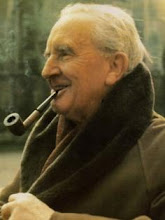
J.R.R Tolkien kept a Rosary forever at his bedside. He was so pious...

Solidarity...


I have to go back out in a minute for the Rosary Procession at my parish, but I thought I'd squeeze a quick post in before so. Yesterday morning at Mass and Benediction I began to think about things I had not really truly considered before. It occurred during the O Salutaris Hostia that I realised that I was chanting along with the very same liturgical hymns that J.R.R Tolkien himself would have chanted. Of course, I knew this before, but I hadn't thought much about it, as it were. This is one of the amazing things about the Catholic faith; it is catholic across time as well as space - linguistically too, not just in terms of the faith. Since the genius of the Church is to use a non-vernacular Sacred Language, the best of them all too (I love Latin!), we can rest assured that perhaps unlike our ''separated brethren,'' our common faith as Catholics is exactly the same as the faith of all the holy and heroic Saints and Confessors who came before us, such as St Edward the Confessor, or even closer to our own time J.R.R Tolkien (my mother was a school-girl when he died).

I had thought of taking down the previous post (someone at my parish had read it), but it received an encouraging comment, and perhaps by venting frustration in some small way we can clear the way for God's Grace. Small things at a time...

The above painting is probably my favourite depiction of The Crucifixion, and is by the Renaissance master Pietro Perugino. Michelangelo was of course not the only one who painted the Sistine Chapel!

Saturday, 3 October 2009

Lessons in humility...

Today is the Feast of St Therese of the Infant Jesus. I have no particular devotion to her, but Fr Finigan spoke of a certain incident in his Sermon on her life this morning - that she was accused (wrongly) by her Mother Superior (who didn't like her very much) of breaking a vase, amongst other imperfections against the Holy Rule, but that she just apologised and carried on. This is an example of true humility - the ability to accept gratefully any humiliation or wrong in the knowledge that it is as nothing compared with the suffering of Our Lord. It is all well and good feeling remorse about our faults during Sermons and Liturgy though, but actually living out the Christian life is infinitely more difficult. I have just come in from an agonizingly bad day at work (even worse than usual), and thinking about it now (perforce) just makes me realise how spectacularly I fail at humility - or for that matter, just about every other Christian virtue. I cordially loathe my job, everything about it; I find it demeaning and depressing beyond my worst nightmare. Today was especially bad because I was being spied on by a Manager, after which I had a sort of informal ''appraisal'' about how best to offer customer service and other retail merchandising hogwash. I scored 9/10 (probably only that high because I knew I was being spied on), which means that I have to undergo the whole thing again. The thing I failed on was not smiling, not making eye contact and not instigating a conversation with the customer. He did explain to me that a supervisor had informed him that I found eye-contact somewhat difficult, but that still didn't stop him putting the cross in the box. He then went into a well-rehearsed ''lecture'' on more retail rubbish (I am trying desperately not to swear!) and I just sat there nodding, thinking: ''this means nothing whatsoever to me'' (or something conveying a similar sentiment). I then explained in the most diplomatic terms I could devise how the nature of this specific work was unsuitable for me and that I was eager to go back to my old quasi-respectable job.

Later on, I had the ''customer-from-hell'' - a woman with a chip on both shoulders. Without going into details, she just managed to create a scene and cause everyone within the vicinity an inconvenience just because she couldn't add up. After arguing with her for about 20 minutes, a supervisor graciously intervened and I just sat back feeling especially bitter about things. This is what I mean about conveniently forgetting about the requirements of one's faith when thrown in the deep end and asked to put it into practice. I just wish I could get out of it. For what I put up with at work, it makes me almost weep to think about what I am paid for it. The things I would like out of working life are dignity, respect, recognition, quiet, intellect and enjoyment - my current occupation is devoid of all those things, and what is worse, is that the prospect of these desired things is slowly slipping away. I need a miracle, and certainly lots of prayers.

Am I too bitter and dismissive? I may yet be immature in the spiritual life, but perhaps one can say that at least the desire for Christian perfection is there. I just need to clear out the cobwebs of resentment and arrogance so that the light of God's love can pervade over my soul. I may read St Therese's Little Way when I get time, small things at a time and all that.

Friday, 2 October 2009

Oratio Dominica in lingua Eldarum...

For any readers who like this sort of thing, here is the Lord's Prayer in Quenya. Tolkien composed this in the 1950s:

Átaremma i ëa han ëa, na aire esselya, aranielya na tuluva, na care indómelya cemende tambe Erumande. Ámen anta síra ilaurëa massamma, ar ámen apsene úcaremmar sív' emme apsenet tien i úcarer emmen. Álame tulya úsahtienna mal áme etelehta ulcullo.

Násie.

The Lay of Leithian, Part I...


It is told in the Lay of Leithian that Beren came into Doriath the mere shadow of a man, the last Man of Dorthonion, bent and weary with a long exile and the torment of the dark vales of Ered Gorgoroth. But coming upon Lúthien dancing among the hemlocks on a summer evening and all weariness left his limbs and he was as one under a spell of enchantment. But Lúthien fled from Beren, and he wandered once again, only this time he was dumb, but in his heart he called her Tinúviel, which is Nightingale in the tongue of Beleriand. He wandered long, until Autumn and Winter were passed and the first signs of Spring were come, and once again he saw her, dancing upon a hillock, only this time she sang also. The Lay continues:

Thereafter on a hillock green
he saw far off the elven-sheen
of shining limb and jewel bright
often and oft on moonlit night;
and Dairon's pipe awoke once more,
and soft she sang as once before.
Then nigh he stole beneath the trees,
and heartache mingled with hearts-ease.

A night there was when winter died;
then all alone she sang and cried
and danced until the dawn of spring,
and chanted some wild magic thing
that stirred him, till it sudden broke
the bonds that held him, and he woke
to madness sweet and brave despair.
He flung his arms to the night air,
and out he danced unheeding, fleet,
enchanted, with enchanted feet.
He sped towards the hillock green,
the lissom limbs, the dancing sheen;
he leapt upon the grassy hill
his arms were empty, and she fled;
away, away her white feet sped.
But as she went he swiftly came
and called her with the tender name
of nightingales in the elvish tongue,
that all the woods now sudden rung:
''Tinúviel! Tinúviel!''
And clear his voice was as a bell;
its echoes wove a binding spell:
''Tinúviel! Tinúviel!''
His voice such love and longing filled
one moment stood she, fear was stilled;
one moment only; like a flame
he leapt towards her as she stayed
and caught and kissed that elfin maid.

As love there woke in sweet surprise
the starlight trembled in her eyes.
A! Lúthien! A! Lúthien!
more fair than any child of Men;
O! loveliest maid of Elfinesse,
what madness does thee now possess!
A! lissom limbs and shadowy hair
and chaplet of white snowdrops there;
O! starry diadem and white
pale hands beneath the pale moonlight!
She left his arms and slipped away
just at the breaking of the day.

The above image is again by Ted Nasmith - one of his ''sketches.''

A dove looked in...


Here is my translation of that wonderful Sequence Columba aspexit. I had two hours of free time yesterday, so instead of going to read old books of ceremonies or Tolkien, I did some Latin instead (which was probably the best option). It was fun to translate, since it was relatively easy, and it is a wonderfully beautiful piece of Latin. Enjoy!
A dove looked in
through the lattice windows,
where before its face
by sweating, there sweated balm
from bright Maximinus.

The warmth of the sun kindled
and in the shadows shone brightly,
whence a jewel arose
in the building of the temple,
a heart of the purest rich devotion.

He, the lofty tower,
of Lebanon's wood and cypress wrought,
with jacinth and carnelian was adorned,
the city surpassing the arts
of other artists.

The swift hart himself hastened
to the fountain of the purest water,
flowing from the strongest stone
which has diffused the sweet spices.

O painters,
you who are in the sweetest green
of the gardens of the king,
ascending to the height,
when you have finished the holy sacrifice
with the rams.

This artist shines among you
the wall of the temple
he who desired the wings of an eagle
by kissing the nurse Wisdom,
in the glorious fecundity of the Church.

O Maximinus
you are a mountain and a valley,
and in both you appear a high edifice,
where the he-goat with the elephant went out
and Wisdom has been in sweetness.

You are strong
and sweet in the ceremonies
and in the gleaming of the altar
ascending as an aromatic smoke
to the column of praise.

Where you intercede for the people
who reach out to the mirror of light
to whom there is praise on high.

If I have committed any careless solecism, then I ask the pardon of any irate Latinist out there! The Church is indeed gloriously fecund, as Bl. Hildegard says in this wonderful Sequence, because works such as these represent not only a certain mastery of Latin but also the devotion of her sons. I am not aware that anything beautiful has been composed in recent years by any devout and decorous son of the Church - maybe this is because of the general declension in ''Catholicness'' and the near universal loss of Latin in the last however many years. Give me Medieval Sequences anyday over Shine Jesus Shine and guitars! Confessedly, I had never heard of St Maximinus before I came across this Sequence, but whenever his Feast day is in the Old Rite, we'll have to make use of this Sequence in his Mass! (I wonder if that constitutes flying in the face of the regrettable Tridentine reforms?)