Today, when I got in from church, I reflected (after my three hour nap - I find that sleeping when I'm depressed helps a bit) a bit on the reception of Holy Communion and I have a few questions to put to readers.
Is it judgemental to think that some people are unworthy to receive Holy Communion? I ask this because I see people going up habitually all the time, as though they are entitled to receive. Are they entirely innocent of the Scriptures and the teaching of the Church?
The Scriptures say: Therefore, whosoever shall eat this bread, or drink the chalice of the Lord unworthily, shall be guilty of the body and of the blood of the Lord. (1Cor 11:27).
And again: For he that eats and drinks unworthily eats and drinks judgment to himself, not discerning the body of the Lord. (1Cor 11:29).
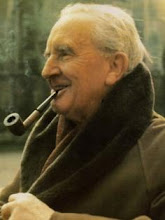
Of course, He alone knows each individual soul and its circumstances, but I often find it annoying that when I go without Holy Communion (because I believe that I am not in a state of Grace and fasting from Midnight) I see people queuing up whom I don't think really ought to have left their place at all. That pious and edifyingly devout man Tolkien made a point of going to Confession every time he received (Humphrey Carpenter, Tolkien's biographer, rather disparagingly remarks that Tolkien had an almost ''Medieval'' insistence on frequent Confession, and that he imposed this on his children and his wife - but then, Carpenter was not Catholic so he can't be expected to understand), and since he went to Mass nearly everyday for most of his life, he must have gone to Confession a lot more than perhaps some modern Catholics do. But then, Tolkien was in favour of daily Communion (''seven times a week is more nourishing than seven times at intervals'' he admonished his son Michael in 1963, then suffering depression and almost coming to lapse), and I am not. I think that St Pius X erred in this, and I would rather people received only on Sundays and Holydays...
Another question: we all know the arguments against reception of Holy Communion in the hand, but why don't old people, long accustomed to this manifest abuse, accept remonstrance from people who know better than they do? The mental image I get when I see people greedily sticking out their hands is like the vision Frodo saw, under the influence of the Ring, in the Tower of Cirith Ungol when Sam offered to help his Master bear the Ring to Orodruin. The text goes:
'''...You'll find the Ring very dangerous now, and very hard to bear. If it's too hard a job, I could share it with you, maybe?'
'No, no!' cried Frodo, snatching the Ring and chain from Sam's hands. 'No you won't, you thief!' He panted, staring at Sam with eyes wide with fear and enmity. Then suddenly, clasping the Ring in one clenched fist, he stood aghast. A mist seemed to clear from his eyes, and he passed a hand over his aching brow. The hideous vision had seemed so real to him, half bemused as he was still with wound and fear. Sam had changed before his very eyes into an orc again, leering and pawing at his treasure, a foul little creature with greedy eyes and slobbering mouth.'' (The Lord of the Rings, Book VI, Chapter I).
Are people who put out their hands to receive like the thieves and robbers Christ speaks of in St John chapter 10? Or are they pitiable people who are entirely ignorant and deserving of our sympathy? I don't understand why people put out their hands even when they have been told that it is intrinsically wrong, but I do often find that some do so out of contempt for the Faith - or at least contempt for the orthodox way of receiving. Such people, in my opinion, do not receive worthily ergo eat and drink judgement and the ancestral wrath of our first parents unto themselves. They must be rehabilitated that their souls might be saved.
Perhaps some of you are now thinking: ''he's off again...''
Sunday, 28 February 2010
Friday, 26 February 2010
Tweed...
A friend has alerted me to this post on another blog. It's about Tolkien's dress sense, which he does mention in one of his letters (not that I can be bothered to look it up, it's from about 1960), saying that he dared to wear in those dull days fine waistcoats and tweed trousers (the money he earned from the publication of his books, which he received in cheques every so often, made his retirement better than his pension alone would have allowed - although he was never extravagent and was generous).
Meantime - Patricius has purchased the iPhone 3G S, which I may regret after several months when the monthly expense starts to take its toll, but I am enjoying it at the moment (I brought it this afternoon straight after work - it's payday you see - an early birthday present). I hearby declare all other phones to be obsolete! I felt like the centre of attention in the parish club after Stations of the Cross this evening! I haven't done a lot to it, since setting the thing up took a while, as well as getting used to various bits and pieces. A friend of mine suggested that I should have spent the money on a Prada handbag to go with my Prada spectacles...
It's all making me feel better; although all this may only be palliative...
Meantime - Patricius has purchased the iPhone 3G S, which I may regret after several months when the monthly expense starts to take its toll, but I am enjoying it at the moment (I brought it this afternoon straight after work - it's payday you see - an early birthday present). I hearby declare all other phones to be obsolete! I felt like the centre of attention in the parish club after Stations of the Cross this evening! I haven't done a lot to it, since setting the thing up took a while, as well as getting used to various bits and pieces. A friend of mine suggested that I should have spent the money on a Prada handbag to go with my Prada spectacles...
It's all making me feel better; although all this may only be palliative...
Thursday, 25 February 2010
Such counsels...
When I published my last post, it put me in mind of this passage from The Lord of the Rings:
'''Pride and despair!' he cried. 'Didst thou think that the eyes of the White Tower were blind? Nay, I have seen more than thou knowest, Grey Fool. For thy hope is but ignorance. Go then and labour in healing! Go forth and fight! Vanity. For a little space you may triumph on the field, for a day. But against the Power that now arises there is no victory. To this City only the first finger of its hand has been stretched. All the East is moving. And even now the wind of thy hope cheats thee and wafts up Anduin a fleet with black sails. The West has failed. It is time for all to depart who would not be slaves.'
'Such counsels will make the Enemy's victory certain indeed,' said Gandalf.'' (The Lord of the Rings, Book V, Chapter VII).
I expect that a Church Militant with all her soldiers locked up inside doesn't go much in favour with the Evangelical doctrines of bearing witness, etc. If only we had a Gandalf though...at least a local one. That pious and apostolic man in Rome cannot see everything, and his saying anything would only be construed in Parliament as yet more outrageous meddling in British politics, even if the very innocence of children is at stake.
Re: my other posts. I may return to them at some point, but I am hardly living in an environment conducive to writing...
'''Pride and despair!' he cried. 'Didst thou think that the eyes of the White Tower were blind? Nay, I have seen more than thou knowest, Grey Fool. For thy hope is but ignorance. Go then and labour in healing! Go forth and fight! Vanity. For a little space you may triumph on the field, for a day. But against the Power that now arises there is no victory. To this City only the first finger of its hand has been stretched. All the East is moving. And even now the wind of thy hope cheats thee and wafts up Anduin a fleet with black sails. The West has failed. It is time for all to depart who would not be slaves.'
'Such counsels will make the Enemy's victory certain indeed,' said Gandalf.'' (The Lord of the Rings, Book V, Chapter VII).
I expect that a Church Militant with all her soldiers locked up inside doesn't go much in favour with the Evangelical doctrines of bearing witness, etc. If only we had a Gandalf though...at least a local one. That pious and apostolic man in Rome cannot see everything, and his saying anything would only be construed in Parliament as yet more outrageous meddling in British politics, even if the very innocence of children is at stake.
Re: my other posts. I may return to them at some point, but I am hardly living in an environment conducive to writing...
Wednesday, 24 February 2010
Another one of those posts...
I am still here. Between work, bella domestici (''home wars'' for those of you who don't know Latin) and other commitments, I have been unable to continue my two other posts. One is about Tolkien's concept of the ''long defeat'' of human history, which I guess is pertinent given current governmental legislation - although I really don't see what everyone is moaning about and why they expected anything different. This is a secular, and therefore evil and Godless, nation, and I expect that in my lifetime I shall see laws passed that make even the mention of Christ's name except in scorn a criminal offence, so why bother complaining or trying to change anything? Politicians, who are corrupt money-grabbing thieves, simply aren't interested in what the Church teaches. As for the notorious absence of the Bishops in this unfortunate conflict, did we really expect any better? The Bishops are incompetent compared with earlier Church standards (didn't St Gregory the Great refuse to consecrate a candidate because he couldn't recite the Psalter by rote?) anyway. The Church should instead focus on personal internal reform (by which I mean doing away with the New Rite) than wasting precious time and energy on the irreligious - these are the Last Days afterall, or have certain Catholics forgotten this? Shake the dust from your feet, expel the wicked from amongst you, etc...If I were able, I would retreat into a small ''family of God'' (a small band of ardent Traditionalists, have High Mass everyday and sung Office with Tolkien in between) and speak Latin all day.
The other post is about General Councils of the Church, how they are notoriously ambiguous, how the office of the Pope requires someone who actually knows how to be Pope rather than an arrogant autocrat (I wonder if Ecumenical Councils teach Popes this?) who thinks he can do as he pleases with the Liturgy, etc. I am also going to (although I haven't so yet) work in some of the Syllabus of Errors and compare it to what Vatican II taught. ''Conservative'' Catholics are often embarrassed by the Syllabus of Errors (apostate ''catholics,'' you know who I mean, are simply not interested in it - that is if they've even heard of it), just like the Genesis Creation story; where it plainly teaches something later contradicted by Vatican II, they shy away from it like out-of-date furniture.
Sigh...nothing has ever been entirely to my taste; Western Liturgy should be longer, Low Mass shouldn't exist etc;...except Tolkien, but then I wish that more of his stuff were complete. He was only human and had many other commitments. When The Lord of the Rings was finally published, roughly 17 years after ''the New Hobbit'' was conceived of, the English Faculty at Oxford said: ''so this is what you've been doing all these years! Now we think it behoves you, Mr Tolkien (he was not a D.Phil, but then most Dons weren't in those days), to do some real work!'' As a philologist, and a very good one (he was a pure philologist - fascinated by language and the form of words purely for the sake of words - Literature was secondary), Tolkien knew more than anyone else in the world. I wonder if he'd have been better off writing treatises on complex aspects of philology and English literature instead of writing The Lord of the Rings? Fame puzzled Tolkien, and he was certainly disturbed by fandom in the '60s, too many hippies, and I'm quite sure he'd repudiate the Peter Jackson trilogy. I sometimes wish that he'd never published The Lord of the Rings or The Hobbit - but that I myself had discovered the manuscript in the Bodleian Library, as a Classical Moderations student...but perhaps this is just selfish of me?
The other post is about General Councils of the Church, how they are notoriously ambiguous, how the office of the Pope requires someone who actually knows how to be Pope rather than an arrogant autocrat (I wonder if Ecumenical Councils teach Popes this?) who thinks he can do as he pleases with the Liturgy, etc. I am also going to (although I haven't so yet) work in some of the Syllabus of Errors and compare it to what Vatican II taught. ''Conservative'' Catholics are often embarrassed by the Syllabus of Errors (apostate ''catholics,'' you know who I mean, are simply not interested in it - that is if they've even heard of it), just like the Genesis Creation story; where it plainly teaches something later contradicted by Vatican II, they shy away from it like out-of-date furniture.
Sigh...nothing has ever been entirely to my taste; Western Liturgy should be longer, Low Mass shouldn't exist etc;...except Tolkien, but then I wish that more of his stuff were complete. He was only human and had many other commitments. When The Lord of the Rings was finally published, roughly 17 years after ''the New Hobbit'' was conceived of, the English Faculty at Oxford said: ''so this is what you've been doing all these years! Now we think it behoves you, Mr Tolkien (he was not a D.Phil, but then most Dons weren't in those days), to do some real work!'' As a philologist, and a very good one (he was a pure philologist - fascinated by language and the form of words purely for the sake of words - Literature was secondary), Tolkien knew more than anyone else in the world. I wonder if he'd have been better off writing treatises on complex aspects of philology and English literature instead of writing The Lord of the Rings? Fame puzzled Tolkien, and he was certainly disturbed by fandom in the '60s, too many hippies, and I'm quite sure he'd repudiate the Peter Jackson trilogy. I sometimes wish that he'd never published The Lord of the Rings or The Hobbit - but that I myself had discovered the manuscript in the Bodleian Library, as a Classical Moderations student...but perhaps this is just selfish of me?
Tuesday, 23 February 2010
Questions about Liturgy and Language...
I am writing two other posts at the moment, but both have been stifled by that awful ''writer's block'' phenomenon. But here are some questions to fill the gap:
Is the ability to understand Latin necessarily a ''good'' in the appreciation of Traditional Liturgy? I ask because I can read the Rubrics of the Missal and most of the Propers and Ordinary with relative fluency. Does this enable me to ''understand'' Liturgy better than your average joe?
What is it that determines whether a language is ''liturgical'' or not? Is it the immemorial use of that tongue, such as the Latin and Greek languages? Modern vernacular tongues are by no means ''liturgical'' languages of course...
Is the ability to understand Latin necessarily a ''good'' in the appreciation of Traditional Liturgy? I ask because I can read the Rubrics of the Missal and most of the Propers and Ordinary with relative fluency. Does this enable me to ''understand'' Liturgy better than your average joe?
What is it that determines whether a language is ''liturgical'' or not? Is it the immemorial use of that tongue, such as the Latin and Greek languages? Modern vernacular tongues are by no means ''liturgical'' languages of course...
Sunday, 21 February 2010
Lethargy...
Blogging may be slow over the next few days, since I've had another dip, and ''bad atmospheres'' have gone off into other spheres than home for me. I was writing a follow-up post to my ''controversial'' post about Rome and the New Rite, and I may return to it, but it's rather long-winded and I don't think I have the diplomacy to finish it. I significantly modified what I thought the Holy Father should say to people who like the New Rite too...Meanwhile, I have to go to work this afternoon (the first Sunday I have worked for years) for lovely stock take. This means that you go around the shop, scan barcodes with a small machine and enter how many of them there are on the shelf (and they say we're superior to the beasts of the field?). It's even worse in the warehouse where it's all dusty and things are less ordered, and you often end up coming across things you counted earlier and you have to go back etc...
One thing only is keeping me from utter despair, and it's neither Tolkien nor Liturgy...
One thing only is keeping me from utter despair, and it's neither Tolkien nor Liturgy...
Friday, 19 February 2010
Does Rome have all the answers?

I often find that when the New Rite is dressed up a bit to look like the Old Rite the result is just farcical. Look at Papal Ash Wednesday this year for instance. I was loath to say anything until a friend emailed me and we had exactly the same grievances. Why are the Cardinal Deacons in Dalmatics rather than Planetae Plicatae? Why are the Cardinals in scarlet rather than violet as is more appropriate for penitential days? It is all in the New Rite and is therefore NOT traditional, even in the slightest, and the spectacle of Cardinals wearing their birettas when not paratus just adds insult to injury. Apropos, why are we supposed to be pleased with it? I thought the Holy Father had more liturgical sense than this...
It all seems to me as though the people in Rome have realised that something has gone wrong in liturgical history and are doing a very fudged job to try and remedy it, getting most of it wrong along the way. ''Oh, if you wear your biretta, your Eminence, I'm sure people with lukewarm liturgical hankerings and no real knowledge will be well-pleased, since you rarely see the biretta in use these days.'' Never mind about when and when not to wear it! If I were the Pope (and I'm sure everyone thinks ''thank God you aren't!''), I would call together all the Cardinals, Bishops, Abbots etc together to Rome, stand up in front of them and say that I repudiate every aspect of 20th century liturgical reform, and that they had better do likewise. Never mind about trying to read things in the light of tradition, which is just a pretentious cop-out and is also Orwellian Doublethink. Something is either good or bad, right or wrong, black or white, traditional or modern. Things can never be both. As regards interpreting things in a traditional context, would you try to read the Qu'ran in the light of Tradition? No, naturally you wouldn't; so why do we try to read things like the New Rite, Nostra Aetate, Unitatis Redintegratio and Gaudium et Spes in the light of Tradition? As Tolkien said of Lewis' idea of the ''miserific vision'' it is rationally nonsense and theologically blasphemous...
What do we do then? If only priests and bishops had ignored what those idiots in Rome said in the '50s. ''I don't care what Rome said, I am observing the Octave!'' You cannot look to Mother Rome when Mother Rome is half infested with Orcs can you? And so, you look to the Tradition of the Church, which is older than Bugnini and Paul VI. I remember from my Latin classes finding something in the Regula Sancti Benedicti that went something like: ''Do not do as the Master does, but only what he says.'' This is good counsel, but I think it rather depends upon the character and honesty of the Master.
So, does Rome have all the answers? Maybe we'll just have to wait a few more years to find out. In the meantime, certainly don't do as they do in Rome, since they're doing everything wrong, just stick with the Old Rite and maybe Rome can look to Tradition and to us traditionalists instead of her own ideas about Tradition...
Thursday, 18 February 2010
I'm still alive...
Forgive the lack of posts recently, but my ISP had a major crash locally. I rang them, only to be told by a computer that they were aware that there was a problem and that we weren't the only ones. I was beside myself with wrath at one point (apparently not a pretty sight), and threatened to leave only my ''calm and reasonable'' mother took over and managed to get us back on. In all honesty, not having had the Internet for almost three days was like being amputated. Indeed, I would go so far as to echo Tolkien's sentiments when he lost the use of his right arm...sometime towards the end of his life (I can't for the life of me find the letter, but it's in there somewhere - if anyone else finds it, do let me know!): that being deprived of the ability to write properly was (to him) like the loss of a bill to a bird.
Updates: I don't feel as depressed as I did, in spite of one or two setbacks. My book proposal was rejected (blast the publishers - this is probably because I didn't enclose a CV - what difference does my work experience make to my ability to write?). Nevertheless, it's been a good week. Most of my books have arrived. The one on ''Greek Love'' is very interesting, although off-putting since it was written by a flaming iron hoof (I should have guessed that when I brought it - I'm going to read it cover to cover though). The others are interesting too. Hildegard's Symphonia is interesting, but irritating sometimes, but I find a lot of Medieval Latin to be inferior anyway. My libellus on Catullus arrived, which Fr Tim was delighted with. It's an old school textbook, and was only 64p! It's a collection of his poems with academic notation and vocab. The Introduction is well worth the read! May blog on this soon. I was asked by Zephyrinus to blog more on Bl Hildegard this evening, so I may devote some time to this tomorrow, now that I am off work. My other book was recommended by a friend and is called Benedictio Aquarum in Vigilia Epiphaniae (The Blessing of the Waters on the Eve of the Epiphany). It's very interesting, since it contains not only two Roman forms, but the Greek, Syriac, Coptic and Russian equivalents. The first Roman form is about 42 pages long; the second one (approved by the SRC in 1890) is two. I have never seen the solemn blessing of waters before, but having gone through this book, I imagine it to be quite magnificent. Maybe we could do it at Blackfen next year...?
Meantime, I am going to bed.
Updates: I don't feel as depressed as I did, in spite of one or two setbacks. My book proposal was rejected (blast the publishers - this is probably because I didn't enclose a CV - what difference does my work experience make to my ability to write?). Nevertheless, it's been a good week. Most of my books have arrived. The one on ''Greek Love'' is very interesting, although off-putting since it was written by a flaming iron hoof (I should have guessed that when I brought it - I'm going to read it cover to cover though). The others are interesting too. Hildegard's Symphonia is interesting, but irritating sometimes, but I find a lot of Medieval Latin to be inferior anyway. My libellus on Catullus arrived, which Fr Tim was delighted with. It's an old school textbook, and was only 64p! It's a collection of his poems with academic notation and vocab. The Introduction is well worth the read! May blog on this soon. I was asked by Zephyrinus to blog more on Bl Hildegard this evening, so I may devote some time to this tomorrow, now that I am off work. My other book was recommended by a friend and is called Benedictio Aquarum in Vigilia Epiphaniae (The Blessing of the Waters on the Eve of the Epiphany). It's very interesting, since it contains not only two Roman forms, but the Greek, Syriac, Coptic and Russian equivalents. The first Roman form is about 42 pages long; the second one (approved by the SRC in 1890) is two. I have never seen the solemn blessing of waters before, but having gone through this book, I imagine it to be quite magnificent. Maybe we could do it at Blackfen next year...?
Meantime, I am going to bed.
Tuesday, 16 February 2010
Music and Low Mass...part one?

This is not going to be a complex treatise on Music and Low Mass...I am sorry to disappoint, but I know nothing whatsoever about Liturgy - I merely ask questions. Towards the end of her life, Bl Hildegard of Bingen was placed under ecclesiastical Interdict for having a nobleman, formerly excommunicate, buried with rites within the monastery grounds. Interdict means that she was not allowed to assist at Mass, receive the Sacraments or sing the Office. She was permitted, however, to say the Office in choro. It is likely that there were ''politics'' involved, and some jealousy on the part of the local Ordinary in the decision, but I know too little of the unfortunate circumstances to comment. Anyway, for months of utter silence Hildegard meditated upon the place of Sacred Music in the Divine plan. And so, she sent an appeal to the prelates of Mainz in which she set down her thoughts on the theology of Sacred Music, concluding with a prophetic warning against the enemies of music. She says: ''beware, before you use an interdict to stop the mouth of any church of God's singers...lest you be ensnared in your judgements by Satan, who lured man away from the celestial harmony and the delights of paradise.'' She goes on to warn the erring prelates that if they do not repent ''they will forego the fellowship of the Angelic praise in Heaven, for they have unjustly despoiled God on earth of the beauty of His praise.'' To silence music in Church, therefore, creates an artificial gulf between the celestial harmony in Heaven and the harmony on earth, to put asunder that which God had joined together by His Incarnation.
Music is integral to the Sacred Liturgy. Surely to silence the Liturgy is to put a gag on it? To do some violence or something unnatural to it? You simply cannot get away from the fact that Low Mass is the worst example of a minimalist approach to Liturgy. You should do everything within your means to make the Liturgy as solemn as possible. Anything less is less than litourgia.
I must say again: down with Low Mass, up with sung Office. Low Mass is just horribly wrong, and arguments for it being ''silent,'' ''conducive to private prayer,'' or whatever other nonsense are just stinking red herrings and hot air. This maybe continued...
The Madness of Carcharoth...

Three new books arrived for me this morning (some Hildegard of Bingen; her style of Latin is unique but she can sometimes annoy me because she can't spell! and a book on Greek pederasty - is that a ''morbid'' interest I wonder?), so blogging might be slow over the next few days. My mother might tell you how engrossed I get in an interesting book; it's rather strange, I become oblivious to the outside world! I have long decided my Lenten abstinence, so I indulged in that for the last time (hopefully) for a while yesterday. The thing about my Lenten penances is that I try to carry them over and beyond Easter, but this doesn't always work. Lord willing, I shall be more successful this year. In the meanwhile, let's return to the Lay of Leithian. The Lay was incomplete, and we reached a fateful moment in the last post, but it suddenly cuts off. Tolkien composed various sketches for later stanzas, but I will leave all that out and rely now upon the narrative of The Silmarillion.
Beren thrust the holy jewel into the face of the great Wolf Carcharoth, saying: ''Get you gone, and fly! for here is a fire that shall consume you, and all evil things!'' But Carcharoth was not daunted, and gaping he bit the hand of Beren, still clutching the holy jewel, at the wrist. Suddenly, all his innards were filled with a devouring fire that ate away at him. Howling, he fled before them down into Beleriand, and all the creatures of Morgoth fled before him, such was the horror of his onset. Beren lay in a swoon before the great gates of Hell, for there was venom in the fangs of the Wolf, and Lúthien did all she could unaided to staunch and heal the wound. But they were in dire peril, for behind them in Angband was heard the rumour of fierce wrath suddenly kindled. The hosts of Morgoth were aroused from sleep.
Thus the Quest of the Silmaril was almost doomed to utter failure, but they were saved. For Huan the wise was vigilant, and he had bidden all things watch that they might render the lovers aid. Thus, even as the darts and bolts of the enemy assailed them, Beren and Lúthien were saved by Thorondor the mighty Eagle and his vassals, and souring above the lightning they escaped the wrath of Angband only just. Fire belched forth from Thangorodrim, and there were great quakes that rent the earth, and the lands about were ruined. Thorondor passed over Anfauglith, Taur-nu-Fuin and came over the hidden vale of Tumladen, and Lúthien beheld the white city of Gondolin amid the green jewel of the plain. But she wept, for Beren did not speak and she thought that he would surely die. The eagles set them down at the borders of Doriath and returned to the mountains...
Art: Ted Nasmith.
Monday, 15 February 2010
More Catullus...

Last night, I was reading more Catullus. This poem was hard at first, because I always look at the first word - a fundamentally English vice (would that Latin were my mother-tongue). This poem is about fidelity.
Iucundum, mea vita, mihi proponis amorem
hunc nostrum inter nos perpetuumque fore.
Di magni, facite ut vere promittere possit
atque id sincere dicat et ex animo,
ut liceat nobis tota perducere vita
aeternum hoc sanctae foedus amicitiae.
You promise me, O my life, that this, our love
will be pleasant and everlasting between us.
Great Gods, grant that she be able to promise truly
and that she says this sincerely, and from the soul,
so that it may be lawful for us to lead through life
this eternal covenant of holy friendship.
Notice that iucundum (pleasant) is the first word. A more ''English'' or simpler Latin construction would be: mihi proponis hunc amorem nostrum inter nos iucundum perpetuumque fore (thanks to The Cambridge Latin Anthology). I had a similar difficulty when trying to translate St Augustine's introduction to The City of God - both main verbs (defendere and suscepi respectively) were halfway down the page!
I find most modern ''poetic'' translations irksome, because they do not translate faithfully. Edward Caswall's translations of Aquinas' Eucharistic hymns is a prime example. Caswell was a skilled Latinist, but Tantum ergo Sacramentum veneremur cernui does not mean ''down in adoration falling, lo! the Sacred Host we hail;'' it means ''therefore, heads foremost, we venerate so great a Sacrament.'' This is, incidentally, why we make a profound bow at ''veneremur cernui.'' Literal translations do not, of course, capture the beauty of the Latin. No doubt Caswell, and perhaps Fortescue, would accuse me of pedantry and lacking imagination. Translation is an art, but am I sufficient enough an artist to be a translator (my ideal job)? All I do is read, understand, and commit the words to the inferior English tongue.
I am rather bored with Tolkien at the moment, which is why I am doing more Latin. This is clearly advantageous, but for me to be ''bored'' with Tolkien must indicate some underlying problem?
The above photo is of one of my ladies, the beautiful, though notorious, Parisian courtesan Liane de Pougy, who later in life became Sr Anne Mary. She looks like a Gainsborough portrait doesn't she?
Sunday, 14 February 2010
An elegy...

This elegy is one of my favourites. It is a short poem by Catullus, one of the neoterics, whose style I find very attractive. Catullus was in love with a woman he called Lesbia, whom Apuleius identifies as Clodia, the sister of Clodius Pulcher, and he describes her as confident, very beautiful and cultured. However, it turned out that she had a series of affairs, and the style of his love poetry changed as a result. It was quite tragic, but see what you think. The translation is my own:
Odi et amo. Quare id faciam, fortasse requiris? Nescio, sed fieri sentio et excrucior. I loathe and I love. Perhaps you enquire, why I do this. I know not, but I feel it being done, and I am tormented.
Abebooks...
If you love books like me, I'd strongly recommend abebooks.com. They have millions of books on sale, many of them really rare and quite cheap. I know I am hard up at the moment, but I just ordered two new books - an anthology of Bl. Hildegard of Bingen (in Latin with notes) and selections of poems by Catullus (in Latin with notes). They were 81p and 64p respectively...
Saturday, 13 February 2010
A full day...

Today was the Day with Mary at Our Lady of the Rosary, Blackfen. I arrived at the church at around 9:20am to help set up, but there was little for me to do. The Day with Mary is now quite familiar, having experienced it many times (last year I had to rush off to work after Mass, but I didn't have to undergo this unfortunate declension this year!) in various churches. We went in procession into the choir for prayers and devotions, the crowning of the Statue etc, after which we had an outdoor Procession with the Joyful Mysteries. Mass began afterwards, Cum Iubilo (my personal favourite), and Fr Tim preached a varied and edifying sermon on Mary's role as the Destroyer of Heresies; after which we had lunch. I brought my own lunch and sat down to read Catullus in the car park, but it was too cold and noisy out so I went inside. It was here that I had a chat with two good friends of mine, who ''put things into perspective'' for me (as my mother often says - I lack ''perspective;'' being too wrapped up in myself). It was edifying. Often I complained to my mother, when she said things about perspective, that this was just a veiled way of saying: ''there are others worse off than you are, so you have no right to complain about anything.'' Yes, I suppose this is a way of looking at it, but perspective is always good to have, even if it doesn't alter the way we feel about things. I still feel sour about University and the domestic situation - and a host of other things - but perhaps the enveloping bitterness is mitigated somewhat by perspective. Having contact with people is a blessing in this sense. One of the characteristics about the Autism Spectrum is an inherent desire (inherent in the sense that this is the ''fulfillment'' (again, where is Tolkien the master of words when you need him?!) of being a desire to be ''alone'') to be alone, perhaps more than is healthy for a human being, who is necessarily a social being - even hermits, physically alone, feel the presence of God. But being alone all the time is manifestly disadvantageous. If I had spent the day at home, refusing contact with the world, then perhaps I'd have crawled up with bitterness and nursed growing sentiments of hatred, etc, etc; don't let us go down that path.
Suffice to say, I was crestfallen, especially about some grievous news. It's funny how all one's troubles pale into insignificance compared with other problems. Anyway, after lunch we went back for Exposition, a Procession of the Blessed Sacrament (I was the umbella-bearer), and more Exposition (there were sermons during Exposition, and there was also a spot-light aimed at the Blessed Sacrament as well...). The Pange Lingua was not sung during the Procession, which I found disappointing, since I adore this hymn, but the Franciscan Sisters led the procession in other pertinent devotions. Afterwards, there were more Rosaries (with the ''Luminous'' Mysteries - which I, of course, avoided - what was that old pagan maxim? ''Nothing can be both new and true''...?) and other devotions. I was tired by this time and desired repose, and so I went into the hall for a cup of tea and to catch up on Catullus, neither of which I got, the place being overrun with noisy children! I adore the children; I think the mere fact of youth is wonderful, and I tend to dislike the old and the sensible (this is, incidentally, one of those unexplained mysteries of Asperger Syndrome - they get on so much better with people either far older than themselves or a lot younger than them. I am not sure why I have adopted a somewhat avuncular disposition to children, but I may devote another post to this soon). The children, however, very often do not understand me...
There was a tea-break at 3:30pm, where I caught up with my uncle's Godmother Maureen (a parishioner at the church for some 50-odd years, she cannot herself remember) and another friend (you must be thinking I did very little prayer at this Day with Mary!). Benediction followed. I was particularly impressed by the fact that the whole congregation joined in singing the Tantum Ergo Sacramentum (the church was filled almost to capacity, and so the force of this hit-home and was quite moving). One of the visiting young servers asked, when we came back into the Sacristy, whether it was ''tissue-time'' yet, which sure enough it was, and we went back into the church to wave good-bye to Our Lady for another year, waving our tissues and singing hymns with the richest sweet devotion. Fr Finigan then blessed the scapulars and miraculous medals and the day was over. After helping to clear up afterwards, I was assured that I was in fact more a help than a hindrance today (a nice change there then!), and I was invited to dinner at a friend's house, which was wonderful. The only bad thing was having to go home afterwards...
I want to assure readers that I have read and digested all your emails, many of which were moving and profoundly interesting. Many thanks for your kind offer of prayers, and I shall for my part hold you in my own prayers, immediately and continually, for what they're worth.
By the way, I don't know if you know, but in my present state of financial want (it's not as bleak as I let on - I just have a tendency to be melodramatic sometimes) I brought a lottery ticket yesterday for the Euromillions (the first I have ever brought). I received an email this evening informing me that there was some ''exciting news'' about my ticket, and thinking that I had won the jackpot, I went to view my ticket. I won £7. That is the last time I shall ever buy a lottery ticket.
Subscribe to:
Posts (Atom)